
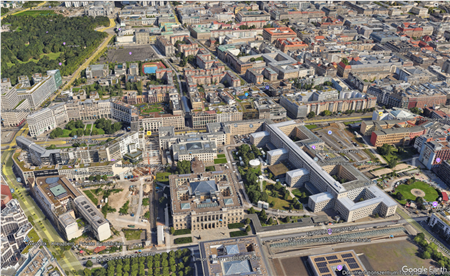
The club's presentation was how Berlin has recovered from the end of World War II and its partition between East and West from 1945 to the current. When asked which European city would the presenter visit again, the quick answer was Berlin. In 1945 the city lay in ruins with 99% of all buildings being damaged in some manner and approximately 60% deemed beyond repair. From 1945 to 1990 the city was partitioned (approximately 50/50) between the Communist/Socialist East and Capitalist West most notably known as the Berlin Wall - an approximate 97 mile strip of land in most areas one block wide that surrounded West Berliners from their Eastern relatives. Berlin itself was surrounded by East Germany, further complicating Cold War politics.
West Berlin was financially supported by the American Marshall Plan and re-infusion of German capital spirited to Argentina and Switzerland in the last years of the war. The West Berlin revival became noticeable with the desire to show a sharp contract between Communism and Capitalism. The Wall was constructed to keep East Berliners from moving to the West. The Eastern half of Berlin remained relatively undeveloped and a very slow revival - rubble well into the 1990s. When the Wall was opened in 1990 money flowed to East Berlin because land was cheap and government subsidies helped spur development. Today, the rapid growth of “awesome” is continuing and many world companies are locating in Berlin. Some examples given in the presentation were:
- Reconstruction of the Reichstag and the government area along the River Spree, now a focal point for outdoor recreation by the population;
- Redevelopment of the area east of the Brandenburg Gate along Unter der Linden Street in corporate offices and hotels;
- Redevelopment of the area south of the Brandenburg Gate, site of the former German Chancellery (plus Hitler's Bunker) , but now the location of the Holocaust Memorial, the US Embassy, and corporate offices;
- Total reconstruction of the Potsdamer Platz, a former no-man's zone of the Wall but now the location of public infrastructure and sky scrappers of corporation offices;
- Redevelopment of the area around Checkpoint Charlie, but with work still to be done;
- Cold War sites shown were: Soviet Memorial to 17,000 buried in mass graves, Guernica Bridge, Checkpoint Charlie, Wall Memorial in Northeast Berlin, the use of the Mauer as a long linear park completely surrounding West Berlin, and examples of area still needing work as ownership issues often hinder development.